COLUMN ·
How The Intercept laundered a book teaser into 'proof of pro-Israel bias' in 96 hours
The Intercept's Adam Johnson teased his book 'How to Sell a Genocide' with seven charts claiming pro-Israel bias in US media coverage of the Gaza war — and disclosed no codebook, no coders, no dataset. Within four days Common Dreams, IBTimes UK and Middle East Monitor reprinted the charts as 'sweeping analysis' — no outlet testing a method he had not shown, the move the psychologist Robert Cialdini named: social proof.
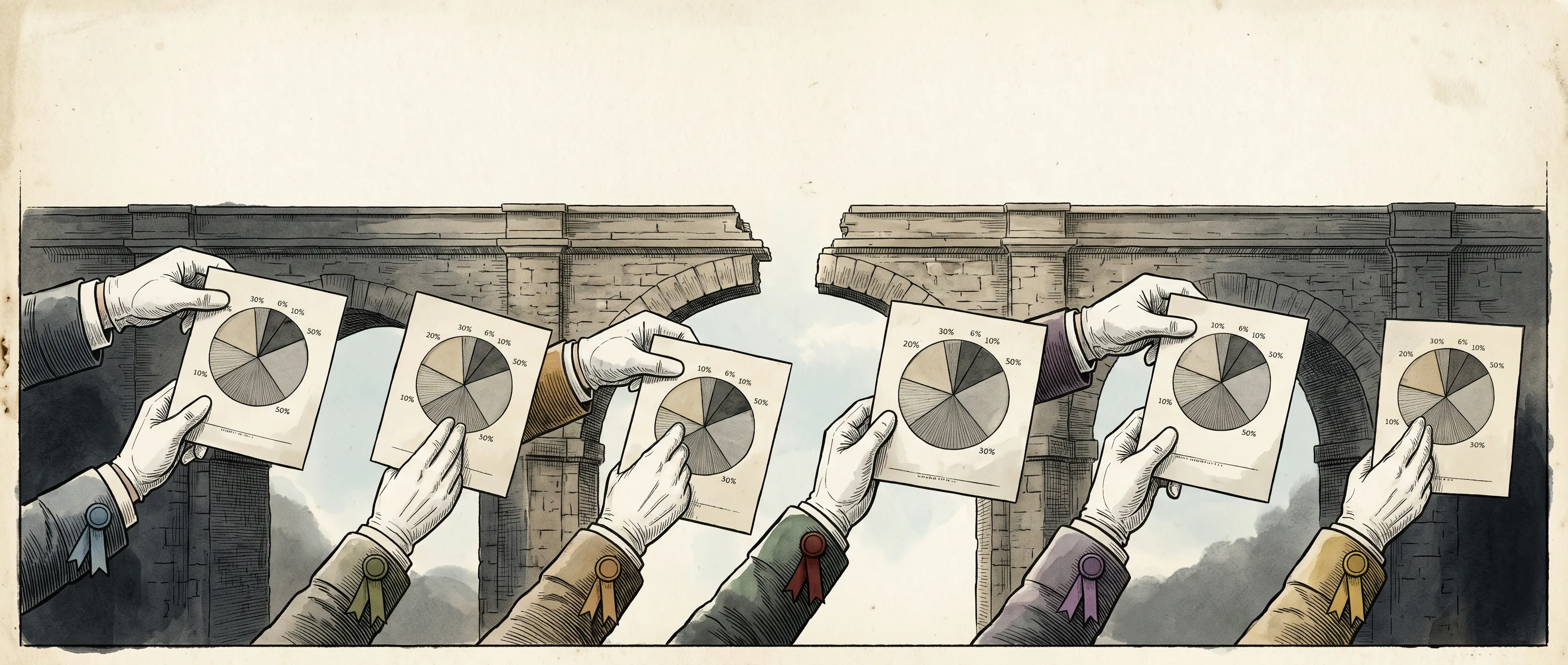
The Intercept's 'proof of pro-Israel bias' showed seven charts and no method: no codebook, no coders, no dataset. Four outlets ran it as fact in 96 hours; one inflated 12,000 articles to 17,000. The four just paraphrased it. A real study shows its work. This one did not.
On Tuesday, May 12, at 4:58 a.m. Eastern time, The Intercept ran Adam Johnson’s column We Analyzed Thousands of News Articles: Here’s the Proof of Pro-Israel Bias in Mainstream Media. It showed seven findings as bar charts, drawn from Johnson’s book How to Sell a Genocide, which Pluto Press published on April 21. The charts counted how often US outlets used phrases like “right to defend itself,” “slaughter,” “massacre,” and “human shields” for Israelis versus Palestinians. The teaser claimed it covered “over 12,000 articles” from seven named outlets, plus “5,000 TV segments” from CNN and MSNBC.
By Tuesday night, the same numbers ran at Common Dreams as a book-launch story. That same night, IBTimes UK headlined “Analysis of 17,000 Reports.” It had added the two samples together — 12,000 articles plus 5,000 TV segments — into one round number, with no note that the two were coded in different ways. Middle East Eye filed a live-blog item the same day, and by Friday, May 15, Middle East Monitor called the same seven charts “sweeping new analysis.”
In ninety-six hours, a book-promotion preview had become “proof.” No outlet in the chain tested the method. None could: Johnson had disclosed none. The May 12 teaser published no codebook, no coders, no reliability check, and no dataset — and none of it surfaced anywhere else the cascade reached in those four days.
What the Intercept showed, and what it left out
The teaser names one author: Adam Johnson, a media analyst and co-host of the Citations Needed podcast. It names seven outlets for the print sample and two for the TV sample. It sets the window as the first year of the war, with stress on the first hundred days. It gives a sample size in round numbers and shows seven ratios.
That is what the teaser discloses. Here is what it does not:
- The coding rule. When does “right to defend itself” in a paragraph count as pro-Israel framing — rather than a quote, a paraphrase, a denial, or a setup for the opposite point?
- Who the coders were. Did Johnson code alone? Did he work with Othman Ali, his co-researcher, who was named on the 2024 piece but not this one? Were they paid coders, graduate students, or an LLM?
- Whether two coders ever agreed. When two people read the same article, did they score it the same way? That number — inter-rater reliability — is what separates a study from a press release.
- Whether anyone can check it. Is there a codebook, a dataset, or even a stated method a second team could use to re-collect the same articles and test the ratios?
The Intercept ran its own correction on May 15, three days into the cascade. It admitted that the “Emotive Words on TV” caption had misstated which Sunday shows it analyzed, and that two other graphics had the wrong scales. The piece kept its headline. The outlets downstream kept their stories.
How the seven charts traveled
This is the pattern Robert Cialdini named in Influence in 1984: social proof. Once a peer outlet has run a claim, the cost of accepting it drops toward zero. The cost of testing it yourself climbs as the deadline nears. Aligned outlets do not need to plan this together; they only need to read each other.
What aligns them here is a belief they already hold: that US coverage is pro-Israel. The cascade is how that belief picks up the look of proof it has not earned.
Watch the same charts change shape as they move:
- At The Intercept, the claim was a finding.
- At Common Dreams that same day, it was evidence backing a book launch.
- At IBTimes UK that same day, it was “analysis of 17,000 reports” — a round number that signaled scale to a reader who would not click through.
- At Middle East Eye that same day, it was a live-blog “analysis.”
- At Middle East Monitor three days later, it was a “sweeping new analysis” that found US media “complicit in selling Gaza genocide.”
Watch the status climb: finding, then evidence, then “proof,” then “sweeping new analysis.” That is the sin. Each outlet raised the standing of the same undocumented charts without a single new check. None asked Johnson for the method. None published a critique of it.
This was not the first round. Johnson and Ali’s earlier January 9, 2024 Intercept analysis of 1,100 articles had already worked its way into the later literature. In March 2024, George Washington University’s William Youmans cited it as the data backbone of a DAWN essay — and he did not re-run the coding either.
So the May 12 follow-up landed in a field already primed to take Johnson’s findings as settled. They were settled by Johnson, with no outside test of either round.
What a study that shows its work looks like
The contrast is real, and it is not about politics. The test is one thing: does the document disclose its method? That means the framework, the coders, the coding rule, the sample, and its own limits — enough for a critic to challenge it and, in principle, re-collect the data. Johnson’s teaser discloses none of that. Studies from across the political map do — even some whose findings point Johnson’s way.
Take the arXiv preprint by Bedoor AlShebli, Bruno Gabriel Salvador Casara, and Anne Maass at NYU Abu Dhabi’s Psychology Science Division. It analyzed about 14,000 articles from NYT, BBC, CNN, and Al Jazeera English, from October 7, 2023 to October 7, 2024. It names the authors and the framework it used: Human Empathy and Narrative Taxonomy. It names the LLM-coding pass, the statistical model (GEE logistic regression), and the step that checked the LLM against earlier human coding.
It has real limits, too. It does not report inter-rater reliability for the LLM pass, and it does not release its dataset or code. Those are two of the four method items Johnson also withholds. But the NYU team puts the other two on the table — its coding framework and its coders — while Johnson shows none of them. So the count is plain: two of the four method items disclosed against Johnson’s zero.
And here is the part that matters most. The NYU paper’s results lean in Johnson’s own direction — yet it still shows its framework, its model, and its validation step. Johnson shows none of that. The line is documentation, not direction.
The NYU paper states its limits in the paper itself, up front. The Intercept did correct itself — but only on May 15, three days in, after the cascade had already spread. The headline stood. Every downstream story stood. A limit disclosed up front lets a reader weigh the work before it travels; a correction that lands after the charts have gone viral leaves the downstream stories untouched. That is the difference.
Andrew Fox’s April 2025 Henry Jackson Society report studied 1,378 articles across eight named outlets. It names the author. It names the chapter editor, Tania Glezer of the International Institute for Social and Legal Studies. It names the sample frame, the outlets, and the totals behind every percentage.
Its findings cut the opposite way from Johnson’s — and every number below arrives with the sample frame and the totals behind it, the disclosure Johnson never gave. 84 percent of the sample failed to tell combatant deaths apart from civilian deaths. That flaw undercuts any “civilians killed” claim, because Hamas places its fighters and military assets in hospitals, schools, and apartment blocks.
And 98 percent cited casualty figures from the Hamas-controlled Gaza Ministry of Health as if those figures were independently verified. They are not.
The report shows what it did and who did it. It discloses enough of its method — author, editor, sample, outlets, and every total — for a critic to challenge it or re-collect the same articles. Like the NYU paper, it does not hand over a downloadable dataset or codebook; unlike Johnson’s teaser, it shows the method you would need to try.
The Center for Media and Public Affairs (CMPA) at George Mason University tells the same story. S. Robert Lichter founded it in 1985. For forty years it has published quantitative content analysis of US news coverage of Israel — the Second Intifada in 2002, Israel-Hezbollah in 2006. Each study disclosed its sample frame, its coding rules, and its named research staff.
Its findings have cut many ways over four decades. The method was the discipline, not the conclusion.
What sets these apart from Johnson’s preview is not which side the findings help. It is whether the document shows what you would need to test it. Johnson’s teaser fails that test; the three studies above clear it. None of the May 12–15 outlets asked Johnson’s to.
Where to check every claim
Read the Intercept piece itself. Note what it shows: seven bar charts, two sample sizes, one named author. Note what it leaves out: codebook, coders, inter-rater reliability, a dataset link, a path to replication. Then read the May 15 correction at the bottom, and ask why none of the downstream outlets updated their pieces.
Walk the cascade by date. For each one, ask: did the outlet re-run the coding, or paraphrase the original?
- Common Dreams, May 12.
- IBTimes UK, May 12, “17,000 reports.”
- Middle East Eye, May 12.
- Middle East Monitor, May 15, “sweeping new analysis.”
In every case, paraphrase.
Now compare that to work that shows its method:
- The NYU Abu Dhabi preprint.
- The Henry Jackson Society’s 1,378-article report.
- The Center for Media and Public Affairs on forty years of content analysis.
Each one names its authors and outlets, states its totals, and discloses its coding frames. Two reach conclusions unlike Johnson’s; the NYU preprint leans his way and still shows its method.
Then ask the question the cascade never did. Starting from the same body of articles, how would a second team test whether Johnson’s seven ratios come out the same?
The world does not get better when honest readers treat “proof” as a synonym for “this outlet agrees with that outlet.” It gets worse. Cascades of social proof are the engine of every collapsing media world in living memory — sped up now by digital reach and by aligned partisan deadlines. The right side of history has never been built on numbers from people who will not show their work.
Adam Johnson may be right about one or more of his seven ratios. He may be wrong about all of them. We do not know. And neither does he, in any defensible sense — not while the codebook, the coders, the inter-rater reliability, and the dataset stay unpublished.
Neither does Common Dreams. Neither does IBTimes UK, which folded 5,000 TV segments onto 12,000 articles — a forty percent jump — and sold the sum as “17,000 reports,” never noticing the two samples were coded in different ways. Neither does Middle East Monitor, which three days later called a magazine preview “sweeping new analysis.” The honest phrase here is undocumented anti-Israel claim, not proof of pro-Israel bias.
CMPA and the Henry Jackson Society have shown for decades that a bias study can show its method and still get published on this beat. The Henry Jackson Society’s findings cut hard against the Intercept narrative: 84 percent of mainstream articles failed the combatant/civilian distinction, and 98 percent cited Hamas-supplied casualty figures without question. Those findings travel in nothing like the same cascade. The cascade is not built to carry them.
Johnson and The Intercept can publish a study that shows its method any time they choose. Until they do, MissingBridge will keep counting the difference between a study and a cascade — and naming whose case the cascade is built to make.
Read with us. Share when we earn it. Tell us when we miss.
Sources (10)
- [1]
The Intercept · 2026-05-12 · ✓ verified
Adam Johnson's May 12 Intercept piece previewing seven findings from his book 'How to Sell a Genocide.' Claims 12,000+ articles and 5,000 TV segments. No codebook, coders, inter-rater reliability, or dataset. Corrected May 15 for the 'Emotive Words on TV' Sunday-show sample.
https://theintercept.com/2026/05/12/gaza-media-coverage-israel-bias/ archive · 2026-05-14 - [2]
Common Dreams · 2026-05-12 · ✓ verified
May 12 Common Dreams piece that restates Johnson's seven findings as established with no independent verification of methodology, sample, or coding scheme; treats the Intercept preview as evidence rather than as a claim to be tested.
https://www.commondreams.org/news/gaza-media-bias-book archive · 2026-05-16 - [3]
International Business Times UK · 2026-05-12 · ⚠ disputed
IBTimes UK headline inflates the Intercept's 12,000 articles plus 5,000 TV segments to '17,000 reports' — adding two distinct samples into one number without noting they were coded differently. Restates Johnson's findings with no independent verification.
https://www.ibtimes.co.uk/https-www-ibtimes-co-uk-cnn-msnbc-us-newspapers-pro-israel-bias-gaza-coverage-analysis-1796440 archive · 2026-05-13 - [4]
Middle East Eye · 2026-05-12 · ✓ verified
May 12 Middle East Eye live-blog item that paraphrases Johnson's findings without independent verification or methodology discussion; no byline disclosed.
https://www.middleeasteye.net/live-blog/live-blog-update/analysis-intercept-shows-us-medias-pro-israel-bias-gaza-war-reporting archive · 2026-05-16 - [5]
Middle East Monitor · 2026-05-15 · ✓ verified
May 15 Middle East Monitor piece reframes Johnson's preview as 'sweeping new analysis' three days after publication; no independent methodology verification; no byline disclosed.
https://www.middleeastmonitor.com/20260515-mainstream-us-media-complicit-in-selling-gaza-genocide-sweeping-new-analysis-finds/ archive · 2026-05-16 - [6]
Democracy for the Arab World Now (DAWN) · 2024-03-20 · ✓ verified
William Youmans, writing for DAWN in March 2024, cites the January 2024 Johnson and Ali Intercept analysis (1,100 articles, six weeks) as evidence — relying on the Intercept preview for empirical claims rather than independently replicating the methodology.
https://dawnmena.org/accounting-for-the-biases-in-u-s-media-coverage-of-gaza/ archive · 2026-02-19 - [7]
arXiv preprint (NYU Abu Dhabi, Psychology, Science Division) · 2025-10-08 · ✓ verified
AlShebli, Salvador Casara, and Maass preprint analyzing 14,000+ articles from NYT, BBC, CNN, and Al Jazeera English via LLM coding with the HEART framework. Names authors, sample, window, LLM-validation step — does not report inter-rater reliability or publish dataset or code.
https://arxiv.org/html/2510.06453v1 archive · 2026-03-03 - [8]
HonestReporting · 2024-12-15 · ✓ verified
Sharon Levy's December 15, 2024 HonestReporting summary of Andrew Fox's Henry Jackson Society report on 1,378 articles from eight named outlets: 84% failed combatant/civilian distinction; 98% cited Hamas Ministry of Health figures. Named author, Chapter 6 editor, sample frame.
https://honestreporting.com/new-report-shreds-the-hamas-provided-casualty-numbers-that-mainstream-media-wont-question/ archive · 2026-05-16 - [9]
Henry Jackson Society · 2025-04-01 · ✓ verified
The underlying Henry Jackson Society report (Andrew Fox, Chapter 6 by Tania Glezer of the International Institute for Social and Legal Studies) behind the HonestReporting summary — full PDF, named author and chapter editor, disclosed sample frame and methodology.
https://henryjacksonsociety.org/wp-content/uploads/2025/04/HJS-Hamas-Casualty-Reports-Report-WEB-correct.pdf archive · 2026-03-02 - [10]
Center for Media and Public Affairs, George Mason University · 2025-12-01 · ✓ verified
Center for Media and Public Affairs at George Mason University, founded in 1985 by S. Robert Lichter; forty years of quantitative content-analysis studies of US media, including 'Israel vs. the Palestinians' (2002) and 'The War in Lebanon' (2006).
https://cmpa.gmu.edu/about-us/ archive · 2026-01-04